How To Increase Your Chances of Landing That Book Deal

While it may seem that my life revolves around short-form magazine pieces about vibrators and low libido, what some of you may not know is that — once upon a time — I worked full-time for a book publisher, weeding through book proposals, drawing up author contracts, and developing marketing/publicity plans.

And so, while I’ve not yet courted traditional authorship myself, I do sometimes help clients with book proposal preparation and lit agent research.

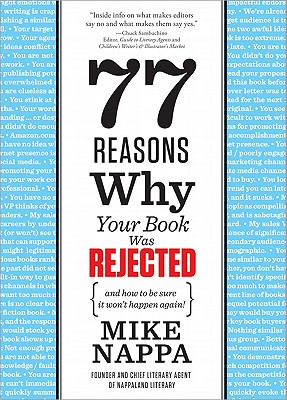
In fact, as I’ve learned from working on several ebooks for Good in Bed, it’s a pretty short leap from being a short-form freelance writer to putting together an entire book. Which is why I thought some of you might be interested in 77 Reasons Why Your Book Was Rejected {and how to be sure it won’t happen again!}.

Because perhaps you have a book in you, too?

ANYway. After receiving a review copy of 77 Reasons and tweeting it up, a friend of mine (a published author who probably bristled at the admittedly provocative title) commented that I should give the book — and anyone who rejected me — “the Middle Finger, and then start looking for other smarter publishers/agents.”

I understood where he was coming from. After all, stories like the one surrounding The Help show that sheer determination, and an unwillingness to give up, can lead to authorial success.

But aspiring authors should be aware that some level of effort is still required on their part to increase their chances of getting a lit agent and/or a book publisher to sign on the dotted line. While writing an entire book is a daunting prospect to most of us, and we admire and envy those of you who can pull it off, that accomplishment does not, unfortunately, grant you a golden ticket to traditional publication.

Enter 77 Reasons.

Its author, literary agent and former acquisitions editor Mike Nappa, doesn’t leave much to chance. Throughout the book, he provides readers with the many reasons an editorial board, marketing department, or sales team might pass on your book, and then gives tips on how to avoid each of these pitfalls. He also gives aspiring authors an inside look at the book proposal consideration process, which may make readers amazed that any book has ever made it to publication.

Some of the pitfalls and pointers may seem common sense, but I feel confident that anyone in the midst of pulling together a book proposal will find value in this book. In fact, I suggest keeping it around on your reference shelf and using it as a checklist once you’ve pulled your proposal together.

It can only strengthen subsequent drafts.

Related: Breakneck Book Report: Adair Lara’s Naked, Drunk, and Writing, How To Get Your Book Published Before the Age of 25, Breakneck Book Report: How To Become a Famous Writer Before You’re Dead


You Need To Wear Many Hats… But You Shouldn’t Wear Them All

You can't wear ALL the hats. You'll just look silly.

Last month, I wrote a piece on spec for a new online startup. I wouldn’t typically do such a thing, but I was excited about the forthcoming website, and the project was backed by several companies I admired.

When the piece was killed, I was disappointed, but the editor I was in contact with assured me it had nothing to do with me. She told me that her and her superiors liked my writing style, and wanted to give me another assignment. Despite misgivings, I went ahead with it, working my ass off to get the piece done before deadline.

Then, the second piece was killed. We like your writing, the editor wrote to me, but the two posts you’ve written for us fail to demonstrate an understanding of what people are interested in or intrigued by.

Lemme tell you. That email really ruined my day.

Yes, I was angry at myself for doing work on spec. Twice. But I was more upset because I felt insulted by the implication that I didn’t know what people wanted to read… and I was the target audience!

I started to doubt my abilities as a writer. (Surprise, surprise.) I knew that anonymous commenters and online trolls were best ignored, but editors? Where could I go from here?

Then, a well-paying job floated in from a new client. Another regular client approached me with several more projects. I talked another editor into doubling their rates for me. I landed a new coaching client.

I realized:

I can’t please everyone. Nor should I want to. Because when you try to write for everyone, you end up writing for no one.

I’m not implying you should ignore contrary comments from your editors because you’re awesome and perfect and poop word glitter. No. Please do take that constructive criticism from the editors whose judgment you trust, and use it to become even awesomer.

What I am saying is that you can’t be the right fit for every editor. And that’s okay.

Take what you excel at and for the love of god run with it.

Have you ever received criticism from an editor that gave you pause? How did you bounce back?

Related: They Hate Me! They Really Hate Me!, The Vulnerability of Writers, Has the Editing Process Crushed Your Soul?, Walking in Someone Else’s Shoes

How To Rock Your Business When You’re On the Move

Why yes, this IS the sexy Colin Wright.

I daydream a lot about leaving the area where I’ve been living for the past 31 years. I think of going back to Graz, Austria, for an extended stay. I beg my husband to consider moving up to Boston. When he shoots down that idea, I suggest relocating just a couple hours away to a charming small town in Central Jersey.

“I’ve lived here my whole life!” I tell him. “I want to live somewhere because I chose it for myself… not because I happened to be born there!”

Unfortunately, Michael has a full-time office job in NYC, so we have to stay put. At least for the moment. Which is why I have to live vicariously through the life experiences those like fellow YEC member Colin Wright, who runs his own branding studio while traveling the world. In fact, he travels to a new country every four months.

After reading his latest ebook, My Exile Lifestyle, it occurred to me that Colin might have a lot of wisdom to impart to you guys, on entrepreneurship, maintaining professional networks, and living location independent.

Do you feel that your experiences have made you a better entrepreneur? How?

Hell yes! It’s my belief that being a good entrepreneur is about being hardy, flexible, creative, and curious. Long-term travel really thickens your skin. You have to deal with the bad as well as the good, and you get quite accustomed to uncomfortable situations. Few long-term travelers make it very far without learning to roll with the punches and adapt to strange and novel situations, and that’s something that definitely carries over to the entrepreneurial realm.

Also, you generally don’t travel this way without already being curious, but every answer I find brings with it two more questions, so I’ve found myself becoming more and more interested in EVERYTHING the more I explore. This is a trait that has helped me to a ridiculous degree with my businesses.

What has been the toughest aspect of being location-independent?

Relationships are tricky, because the people you meet know they will only have you in their day-to-day lives for a certain period of time, and therefore may be reluctant to invest much time in you. That’s not always the case, and a lot of people embrace the idea of long-term relationships that take place either online and in real life, in different countries, but it does weird some people out, and there have been a lot of missed opportunities because of it.

I wouldn’t give it up, of course, because new opportunities arise as a result of what I’m doing, but there have been a few moments where I’ve questioned things briefly because of this.

How do you suggest that other location-independent entrepreneurs remain connected to their network, and to their target audience, while on the move?

It’s all about making yourself available — to the extent you want to be available — and creating platforms through which people can access you and your ideas.

For example, I always have a phone number in the countries I travel to, but I also have a Skype number and a Google Voice number for texting in the US. I also try to encourage email contact, and endeavor to get back to people who do email me within 24 hours.

I keep my inbox tidy, of course, but I also try to give people the info they need before they email me by creating products (like ebooks) that convey many of my ideas. My blog serves the same purpose. Rather than explaining the same things over and over, I’m able to write it once, and the connection with my audience is maintained.

Social networks also help quite a bit, as I can keep tabs on what my friends and family are up to on Facebook, and quickly convey information on Twitter.

How do you feel your introversion has affected your ability to start over in a new place every few months, and how do you cope with / manage this particular aspect of your personality? 

It’s something I’ve dealt with for quite a while, and I’ve had the chance to recognize when I need to recharge, and when I’m good to be social. I’ve gotten quite adept (through practice) at forcing the social side of things, too, though I’m incredibly exhausted afterward when I have to do that too frequently.

Because I tend to live alone, though, and because I have a good amount of alone time when I arrive in a new place, I actually don’t have too much trouble making new connections. There’s something about moving and having a new city to explore that gives me a boost and keeps me motivated to get out and talk to people.

You write about extreme minimalism… sort of a must when you’re constantly traveling. Do you have any tips for others who are looking to eliminate the inessentials?

The point of minimalism is eliminating the stuff you’re not passionate about and spending your time, energy, and resources on things that make you giddy. That’s it.

It can be tricky to do this in practice, though, and I’ve found the most success when I have a project that gives me the excuse to break habits and try things out. This seems to help with all the little voices that whisper No, you can’t get rid of that. Your parents gave you that card, and it’s sentimentally important. You know, of course, that the card is not in itself important — your parents and their feelings toward you are — but we’ve been programmed to give things sentimental value instead of the sentiments themselves.

A good place to start would be to go through your clothes and discard anything you haven’t worn in four months. Then, anything you haven’t worn in three months, and on and on, until you’re rid of all the stuff you don’t wear. The feeling you get from clearing out this kind of mental and physical space is enough to give most people the momentum to go on a life-cleaning frenzy, but if that’s not enough, just remind yourself what you’re working toward: more of what you care about, and less of what’s keeping you from it.

And do you have any tips on being financially savvy when you have to consistently come up with the money for travel and lodging? What are some suggestions you have for saving your moolah?

Something that surprised me is that unless you’re staying in 4-star hotels all the way, and doing nothing but eating out for every meal, it’s actually cheaper to travel full-time than to live in a big city. The money I spend on plane tickets and furnished apartments is the money I would have otherwise spent on gas, car insurance, a townhouse, furniture, electricity, etc.

A quick tip I would offer is to make sure that your banking situation is set up so that you have a way of accepting payments online, and that said method is attached to a bank with a high-yield checking account that pays your ATM fees all around the world (there are a few banks that have this, but I use Charles Schwab).


What did you gain from your time in each place that made it all feel worthwhile?

I feel like I walk away with so much more than I came with in each country I visit, to the point where it’s tough to even pinpoint individual items.

Perspective is a good way to summarize some of it. Being able to see things from a similar angle as the locals of a given country is a HUGE asset, and one that has made me a much better person.

Relationships are also very important to me, and I always leave with dozens of new friends, and usually one or two people who are more than just friends. People spend their whole lives trying to find like-minded folk, and I’m fortunate enough to find them everywhere I go, because I cast a wide net, and geography isn’t as much of an issue.

One of my greatest pleasures in life is having new experiences, and traveling to these countries has filled a significant portion of my day-to-day life with new experiences. Every time I try something new, I have a better big-picture view of the world, I’m much more capable of prioritizing and figuring out what I value and think about things, and I’m much more capable of adapting to future novel situations.

What has been your favorite experience so far? Your least favorite?

It’s hard to pick just one, but one of my favorites was playing naked Frisbee and lounging in the natural hot springs in Iceland during the Summer Solstice with a beautiful girl I was dating and a circus performer who did some fire-breathing, which looked really cool in the fog that shrouded the area.

Worst was probably almost getting mugged in Buenos Aires. I escaped, thankfully, after throwing an awkward punch at one of my assailants, but it could have gone VERY wrong, and it was a huge wakeup call for me.

Related: In Favor of Freelancedom: You Can Do It Anywhere


Inch By Inch: How Small Steps Lead To Big Success

Earlier this week, I joined a yoga studio just two minutes from my condo, and started trying out different classes. I had been using Shiva Rea and Rodney Yee DVDs at home, but I wanted to mix things up, and I wanted someone who could tell me when my elbows were pointed in the wrong direction, and who could correct my stance. I wanted someone who could adjust my pose the one iota it needed to be perfect. I wanted to achieve yoga success.

Yesterday afternoon, the instructor had us do headstands. When I admitted I hadn’t done one since I was a toddler, he rubbed his hands together with glee and had me move my yoga mat up against the wall. Then, he walked me through the setup for the position and watched as I struggled to get my legs up above my head.

“Just one more inch,” he said as I flailed about. After a few moments, I let out a surprised “Oh!” as my feet touched the wall.

I left the class feeling exhilarated by how easy it had been to do that headstand. How close I was without even knowing it.

When I got home, there was more good news in my inbox. Thanks to a quick email nudge I’d sent the week before, a lit agent that a client of mine had introduced me to via email wanted to set up a time to chat about my book proposal.

I don’t know what will come of that chat, but I feel similar to how I felt when I was attempting that headstand: So close… close enough for my feet to touch the wall.

Sometimes, people look at my business and feel frustrated that they’re not where I’m at in my writing career. The thing is, it took me over 10 years to get here, and I’m still not even where I want to be. I’m still moving forward. Inch by inch.

It took a lot of self-help books to get here. A lot of continuing education classes and post-college internships, and a lot of query letters. It took a lot of online and in-person networking and a lot of informational interviews. It took full-time and permalance jobs… small and large assignments.

It took a heckuva lot of one-sentence followup emails.

Every year, I look back and am proud of the things I’ve accomplished. But then I look forward and see how close I am to achieving the next big thing. I agonize over a query letter. I send another followup email. I attend an event. I move forward an inch.

For the longest time, I felt I wasn’t going anywhere. It felt as if my wheels were spinning. Today, I turned 31. I can see my progress. I’m excited for what’s next.

How many small steps have you taken this week to move forward that next inch?

What have you already accomplished?

What are you most proud of?

Related: News Flash: Both Marriage and Freelancing Are Hard, Nothing To Do with Luck, Bring in New Projects Without Lifting a Finger

Need New Material? Try Living Your Life

About two and a half years ago, I blogged about feeling limited by the sex writing niche I’d found myself in. Since then, I’ve been an editor at a web magazine featuring content on love and sex, I’ve had my own sex column, I’ve co-written an ebook with Ian Kerner on spicing up your sex life, I’ve been interviewed as an expert on vibrators, and more. When all is said and done, I suppose the sex writing thing has been good to me.

Still, it’s tough to continue getting mileage out of that first sex party I attended five years ago, or that one time I posed nude for a portraitist. Plus, even sex gets boring!

Which is why, in this month’s edition of Word Nerd News, I urged readers to get the hell out of the house and live a little.

I even gave them some homework:

1. Step away from your laptop at least once a week, and try something new.

2. Develop at least three story ideas based upon that one experience, or that one nifty person you met.

3. Send out those queries, dammit.

4. Land some fabulous assignments.

5. Collect a ton of money and immediately spend it all on books and handbags.

The part about handbags is optional, but I’m dead serious about the rest of it. Which is why I’m giving you the exact same assignment.

And just so you don’t think I’m slacking (I may be wearing PJs and bunny slippers at 1:01 p.m., but I’m definitely not a slacker), I’ll take one of the experiences mentioned in my newsletter and do the assignment, too. Here. Let me start us off.

1. My Experience: I hung out at the Trojan Vibrations Truck to talk vibrators and promote sexual health awareness.

2. My Three, Related Story Ideas:

  • how to use toys to enhance foreplay
  • what else I wish I could buy at my local Stop & Shop (playing off the idea that Trojan wants to display their new line at the supermarket, right next to their condoms, as a means of normalizing discussions about sexual health)
  • required reading for your progressive sex ed curriculum (playing off the latest stories of the new sex ed mandates in NYC)

3. Sending out those queries. Dammit. I’ll have them out by tomorrow. I swear.

Okay. It’s your turn. Feel free to share your stories and brainstorm ideas in the comments section of this post!

And if you’re not yet signed up to receive Word Nerd News, get on that, yo!

Related: Cornering the Market? Or Feeling Cornered?

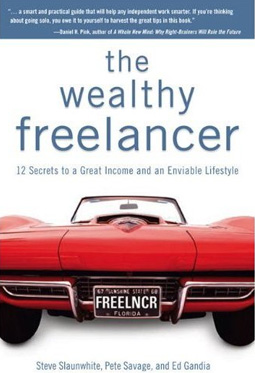
Freelancedom Book Club Discussion: The Wealthy Freelancer

Now that we’re back to business as usual here at Freelancedom, it’s time to focus on the important stuff: Taking our businesses to the next level. Elevating them beyond mere hobbies so that they’re legitimate sources of income. Becoming wealthy freelancers, no matter what wealth means to you.

I had seen lots of online love for Steve Slaunwhite, Pete Savage, and Ed Gandia’s The Wealthy Freelancer before I broke down and picked up my own copy. Why did I wait so long? Being a raging book nerd, with a particular love for self-help-y career titles, I had started to feel as if none of the books I was reading had anything new to say.

The Wealthy Freelancer exceeded my expectations by… well… a lot. As I mentioned in a related post, the book is so much more than inspirational mumbo jumbo. Rather, it contains concrete tips and step-by-step instructions for making it work.

I’m curious to hear if you loved it as much as I did, and whether or not it had anything new to teach you. Just as with last time, I’d love for you to share your thoughts in the comments section of this post, in addition to your responses to the following questions:

1. The authors of this book assert that you can improve your business drastically even if you implement just a handful of the tips in this book. Which tips spoke to you the most, and why?

2. The first chapter of The Wealthy Freelancer (TWF) discusses what being a wealthy freelancer really means, and then challenges readers to explore what wealth means to them, and to write out their ideal day. What does wealth mean to you, and how close are you to really living your ideal day?

3. TWF touts the power of the buzz piece, and lays out what your buzz piece could possibly entail. Have you already created and launched your buzz piece? If so, how did it boost your sales. If not, let’s have a brainstorming party. What types of buzz pieces could benefit your business?

4. Secret 8 of TWF delves into the importance of focus, something I’ve struggled with myself. At times, I’ve tried to do too much, and I’ve had to take care to be sure that everything I was attempting was connected, and easy to convey to others. Do you have trouble answering the question What do you do? Is it time to start cutting items from your list of offerings? Are you trying to be indispensable to everyone? Assignment: Take a good, hard look at what you’re trying to do, and determine where you can trim the fat. Share the results in the comments below. 

5. For me, wealth means being able to pay the bills without having a panic attack every month. It means being able to work at a leisurely pace, and still have time for things like yoga, and Netflix, and lunch. It means being able to prioritize my health instead of burning myself out with an around-the-clock work schedule. The authors of TWF seem to agree that “a wealthy freelancer is a healthy freelancer.” What has kept you from achieving a healthy work-life balance? Which tips from Secret 10 (pages 191 – 194) could you implement now without freaking the eff out?

And finally, what else from TWF leapt out at you? What inspired you? What have you implemented already, and how has it worked for you?

PSA: Steph Auteri Gets Around

It’s been a crazy couple of months. I (ghost)wrote an ebook in six weeks, and am just now wrapping up editing. During that time, I haven’t done much else. (Though I did see a train wreck of a Debbie Gibson / Tiffany concert that was definitely something… special.) Now, I’m heading up to a B+B in Portsmouth, New Hampshire for a wedding / long weekend. Brewery-hopping and kayaking may occur.

We’ll be back to business as usual upon my return — which includes the long-awaited book club post on The Wealthy Freelancer and the latest edition of Word Nerd News — but, before that happens, I wanted to leave you with a roundup of where I’ve been around the web.

Because, well, it seems I accomplished something other than this monster ebook project.

Over on Ebyline, I wrote a post on how to shut down your laptop and land new freelance assignments. The name of the game? Network like hell. And geez… try to have fun doing it.

I also popped up on Mashable, which I thought was exciting. The site’s been an invaluable resource for years and, thanks to the YEC (Young Entrepreneur Council), I’m on the site with my fellow members sharing tips for better startup marketing.

Also thanks to the YEC, I’m on Portfolio‘s website, sharing what I wish I knew about entrepreneurship five years ago.

Meanwhile, Alyssa Martino interviewed me for a post she did up over at Brazen Careerist, on getting your company to fund professional training and development. I’m a huge proponent of continuing education — in all its forms — so I urge you to check it out.

And because I’m a crazy cat lady (some of you may not fully realize the extent of my crazy), I’d like to share my very first Petside piece, on how I landed a husband despite loving my cats more than life itself. It has nothing to do with freelancing, but hopefully you’ll find it to be a fun read!

Finally, and just to prove that I do, in fact, leave my condo (on occasion), I traveled in to Williamsburg, Brooklyn last week to film a Late Night with Logan segment as part of the Trojan Vibrations Truck Tour. I haven’t seen the edited footage yet but, once I’ve ensured that it’s not horrifically embarrassing, I’ll be sure to share it with you. Maybe.

Whew! I have to do up two more blog posts, whip up a book proposal, send out some query letters, and squeeze in some yoga before I leave tomorrow. See you next week!

How Writing Got Me a Spot on the Trojan Vibrations Truck

Bringing good vibes to all the good boys and girls...

I don’t usually promote events here that don’t have a direct link to writing, freelancing, or entrepreneurship, but writing brought me to this odd spot, so I wanted to share.

This coming Friday, July 29, I will be a guest on Late Night with Logan, hosted by sex educator Logan Levkoff. The topic? Oh, the usual. Vibrators. Sex. That kinda thing. The venue? The Trojan Vibrations Truck.

Say what?

Basically, Trojan is going on a truck tour in the style of the city’s popular food trucks, dispensing free Trojan Her Pleasure condoms and Trojan Vibrating Rings while also promoting sexual health awareness. You can read more about it here. Each night, the truck will also become a destination for a late night web talk show, Late Night with Logan. During this talk show, Logan will interview “some of the industry’s greatest visionaries and experts who have helped pave the way for making the conversation around sex and vibrators positive, healthy, and open.” (I’m going to start telling my mom that I’m a visionary.)

I practically squeed when I was invited. I had already seen Logan tweet about the truck tour, and had thought it was a fantastic idea. I myself have been writing about sex for 10 years now, and my initial sex toy reviews have led to a fulfilling career in which I’m able to destigmatize sex issues for my peers using openness, honesty, and humor. I’m thrilled for the chance to participate in something that seems so closely aligned with what I try to do with my writing.

How did I get here? I’ve been doing a lot of work for Ian Kerner and his Good in Bed site lately, and my most recent project was to copyedit Logan’s latest Good in Bed manuscript: How to Get Your Wife to Have Sex with You. (Such a fun — and totally necessary! — book.) She must have found my notes to be helpful because, only a few hours after passing them along, I was contacted about being a guest on her traveling web talk show.

I love how opportunities pop up and surprise me like that!

(In fact, my Good in Bed work came about simply because I’d interviewed Ian for an article in Time Out New Yorkand he liked what he saw.)

This Friday’s Late Night with Logan taping will take place from 8 – 10 p.m., outside the Williamsburg Waterfront at 93 Kent Ave.

You should visit! Not only will I be there, but the truck will be stationed outside a free concert with guests They Might Be Giants, Patton Oswalt, and Kristen Schaal.

If you can’t make it, though, the show will also be broadcast on the Trojan Facebook page and website following the event.

So tell me: What’s the oddest opportunity your writing has brought you?

Spill It: Did You Choose Freelancing, or Did It Choose You?

About four years ago, I walked into my publisher’s office and handed him a resignation letter.

I didn’t do it as a negotiation tactic. I wasn’t trying to force his hand. All I wanted was to give this freelancing thing a shot: to be my own boss, pick and choose my own projects, and have the time and energy to write more of my own stuff.

No salary range… no full-time dream job… could have lured me back to the corporate workforce.

The thing is, many people in my life just assumed I was looking for something better. They didn’t see freelancing as a viable career option. One well-meaning friend even offered to treat me on all future meals: “… just until you find a new job,” she said.

“This is my new job!” I replied.

Now more than ever, it’s easy for the traditionally employed to make this mistake. According to a recent survey, 24 percent of freelancers only went the self-employed route after being downsized.

And while I think that entrepreneurship is a great option for those who have lost their jobs and want to have greater control over their careers, I’m sick of people assuming that the work I do was a last-ditch move made out of desperation.

I feel as if I’m constantly seeking out legitimacy in the eyes of those who just don’t get it: You’ve been published in BLANK? I’ve never read it. You’ve earned your certification for WHAT!? Why would someone pay you for that? You wrote a book? Is it a REAL book? (Um… I earn royalties on it. Does that make it “real”?)

I’m curious: How many of you chose freelancing, and how many of you came to freelancing as a means of surviving unemployment? For those for whom it was a Plan B… are you dying to find a new full-time job, or are you sorta digging this? For those who went full-time freelancedom of their own volition, is there anything that would tempt you back to Corporate America? And how in heck do y’all describe your career to other people in your life?

Related: Crowdsourcing: Does the Corporate Ladder Still Beckon?, Pinpointing Dream Job #328, When I’m Not Home…

Product Placement: Support Entrepreneurs… and Look Good Doing It

You may have noticed that, recently, I put a pretty, pretty new banner ad up in my sidebar for something called Sweat EquiTees. While I typically wouldn’t advertise for apparel on Freelancedom (despite the fact that “shopping for pretty things” is totally at the top of my my top 5 list of favorite hobbies), Sweat EquiTees is different. Their mission is directly aligned with that of Freelancedom, and with everything I’ve been trying to do with my career lately.

I first learned of Sweat EquiTees when familiarizing myself with the other members of the Young Entrepreneur Council (YEC). Benjamin Leis, the owner and founder of Sweat EquiTees — a clothing company for entrepreneurs — was among them. When I clicked through to his company’s website, I immediately wanted to snatch up one of his tees (again: shopping problem). With fun graphics and lines like “Kiss Me, I’m an Entrepreneur” and “Run LLC,” they were right up my alley.

But Sweat EquiTees is more than just a fun apparel shop for biz owners. One dollar from every tee sold is donated to an organization that teaches and encourages entrepreneurship… organizations like The Launch Pad, Extreme Entrepreneurship Tour and, yes, the YEC. In addition, it is Leis’s hope that his T-shirts both promote the entrepreneurs that wear them and inspire would-be entrepreneurs. “The best is when customers tell us that someone came up and asked them about their business because of reading their shirt,” says Leis. “If our shirts can bring people business or create valuable connections, then I think we are doing something really special.”

So why is entrepreneurship so important to Leis? Aside from being a serial entrepreneur himself (he founded his first organization at the age of 18 and now, at the age of 29, has founded six organizations in all), he believes that entrepreneurs are integral to the future of our economy. “They are the ones who will be creating jobs and introducing innovation, filling voids in the marketplace and delivering meaning and value into our lives,” he says.

So yes. Sweat EquiTees isn’t like the products I usually promote here on Freelancedom (pretty notebooks, handy gadgets, and nifty apps), but the company is supporting something I believe in… and something I think you believe in, too.

So order one of these T-shirts, yo. Then we can have a really dorky meetup at which we all wear our T-shirts together. (I know. It’s all you ever wanted.)

Also, if you’d like to contribute to Sweat EquiTees in some other way, check out the contest they’re currently running on their Facebook page. Burgeoning designers can submit their T-shirt ideas for the chance at seeing them become a reality.

Now if only someone could design me a cool-looking “I like big books and I cannot lie” tank top.

Related: Are Professional Organizations Worth the Cost?, Product Placement: The Lapsac, Product Placement: Slippers, Product Placement: Angry Journalists Wear Their Hearts on Their Sleeves